Powering the shift to cleaner heavy transport
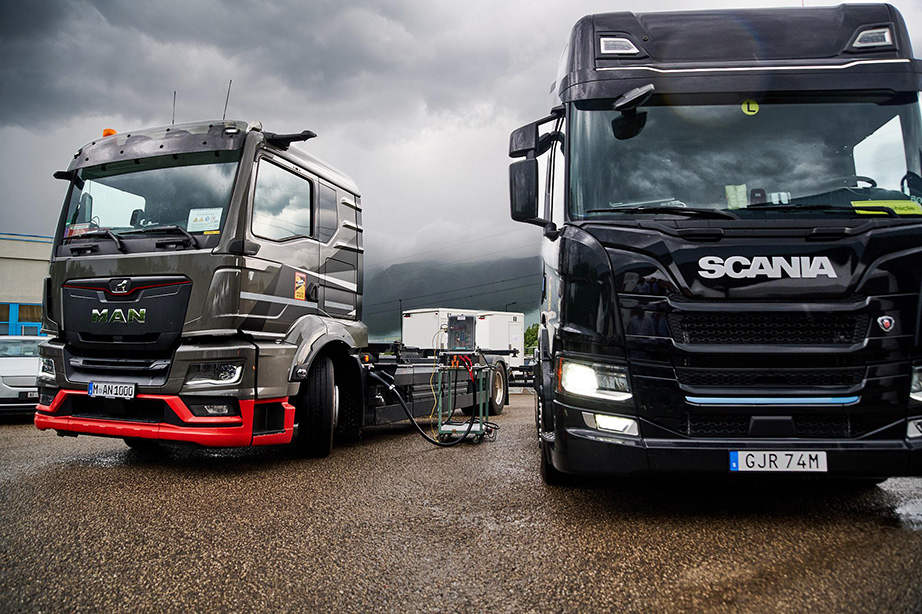
A glimpse from the CharIN Testival 2025 where the Megawatt Charging System testing was accomplished between industry players, including MAN Truck & Bus and ADVANTICS. Photo: C.Krishna/ADVANTICS
The electrification of heavy-duty vehicles and vessels could have a significant impact on global emissions, but the limitations of charging systems have hampered their growth. A new international standard for megawatt DC charging promises to revolutionize the global transport industry, by enabling safe, fast charging with widespread compatibility.
Evidence shows that global warming is accelerating, and that global efforts are failing to meet climate targets. With global freight demand projected to roughly double by 2050, and global trucking demand expected to double in the same time period, electrifying heavier vehicles such as trucks and boats could make a big difference. Yet the limitations of the charging infrastructure remain a barrier, often being too slow for many industrial vehicles and with limited ranges.
Megawatt charging systems (MCS) is an emerging technology that overcomes many of those barriers by enabling fast, high powered charging systems but, until now, systems are bespoke, with limited compatibility between the various industry players.
The publication of a new international standard is tipped to overcome those challenges, enabling the creation of MCS that are widely compatible. By providing a common language and protocol that everyone can use, vehicles and vessels will be able to charge quickly anywhere, greatly speeding up the transition to electrifying industrial transport.
Dr Frederik Zohm, Executive Board Member for Research and Development at MAN Truck & Bus, explains the significance of MCS technology: "Megawatt charging will be a game changer for long-distance freight transport and regular coach services. Charging times can be reduced to such an extent that vehicles can be operated on long-distance routes without restrictions, comparable to today's situation.”
IEC TS 63379 provides the standard interface configurations of vehicle charging connectors and accessories needed for conductive charging at megawatt levels. It covers everything from the hardware to the pin and contact concepts, safety requirements, thermal management and temperature monitoring, power levels, bidirectional charging and robustness for operating in extreme conditions.
It will be complemented by IEC 61851-23-3, currently in development, which will specify supply equipment to provide energy transfer between the supply network and electric vehicles. These standards will work in conjunction with the rest of the IEC 61851 series dedicated to EV conducive charging systems, but be specific to MCS.
Niklas Dahlberg is a project manager at Swedish company Metstech that specializes in electrical and automation technology in the maritime sector. He says the standard will have a big impact in Sweden, a country that is leading the way in electric ferries and where the Swedish Transport Administration is pushing for net zero emissions by 2045.
“We see a big market for ferries going electric both in Sweden and in surrounding countries such as Finland and Denmark, and there is pressure by the Swedish transport authorities to meet their goals of being all-electric,” he said.
“High powered charging exists already, but the systems are bespoke, meaning a vessel can only charge at ports that have the same system. Therefore, to meet the goal of electrifying the whole Swedish Archipelago, where there are many different ferry companies and many different ports, the standard will be a huge help.
“Without the standard, all the different companies would have to agree on how the systems should be set up, which could be long and complicated and there would always be a compromise. With the standard, everyone will be automatically on the same page, saving a lot of time and complexity.”
Amin Saidi is Lead Software Engineer at ADVANTICS, a French company specializing in power converters for MCS applications and communication technologies between vehicles and chargers. They are one of the few in the industry to design and manufacture their products wholly in Europe.
He said the standard is necessary for the electrification of heavy-duty vehicles to take off at a large scale.
"MCS demands a fundamental rethink of the underlying power electronics. The technology behind today's Combined Charging System (CCS) simply wasn't designed for the high voltage levels that heavy duty transport requires, being limited to 1000V. We have developed 1500V power modules that can be stacked to deliver up to 6MW, precisely to meet that challenge, enabling more powerful and faster charging for rugged MCS applications."
“But none of the technology could have widespread adoption without interoperability between the vehicle, the charger and the communication between the two. This is what this standard provides, a common language and protocol, so that ultimately, heavy-duty vehicles and vessels can charge anywhere, encouraging the transition to electric at a much faster rate.”
Collaboration is key
Bernd Horrmeyer, Chair of the IEC technical committee that developed IEC TS 63379, said CharIN e.V., the global association dedicated to promoting standards in the field of EV charging systems were key drivers of the standard, seeing the need for an internationally agreed solution to rapidly charge electric heavy-duty vehicles.
“This cooperation between a consortium and the IEC is a groundbreaking example of the power of collaboration that international standards represent, and the impact they can have on the world.”
Michael Keller, Chief Technology Officer at CharIN e.V. said standardization is a key enabler for scalable, interoperable e-mobility. “This new standard for MCS marks an important step toward global alignment across industry stakeholders, accelerating adoption and ensure a seamless charging experience across markets. At CharIN, we see this collaborative effort as essential in driving innovation, reducing fragmentation, and supporting the integration of e-mobility into the energy system, which supports the global transition to sustainable mobility."